

The baboon is one of Africa’s most recognizable and adaptable primates. Known for its powerful build, long muzzle, prominent canine teeth and highly organized social life, the baboon can survive in environments ranging from open savanna and woodland to rocky hills and semi-desert landscapes.
Baboons belong to the genus Papio and the Old World monkey family Cercopithecidae. Unlike many monkeys that spend most of their lives in trees, baboons are primarily terrestrial. They spend much of the day traveling, feeding and interacting on the ground, although they remain capable climbers.
For anyone interested in African wildlife, understanding baboon species, regional distribution, habitat and behavior provides valuable insight into the ecosystems they share with many other iconic animals.
Baboon Quick Guide
| Feature | Details |
|---|---|
| Genus | Papio |
| Family | Cercopithecidae |
| Group | Old World monkeys |
| Main range | Africa and parts of Arabia |
| Lifestyle | Primarily terrestrial |
| Diet | Omnivorous |
| Common habitat | Savanna, woodland, rocky terrain and semi-desert |
| Social group | Troop |
| Activity | Mainly daytime |
| Key strength | Exceptional ecological adaptability |
What Is a Baboon?
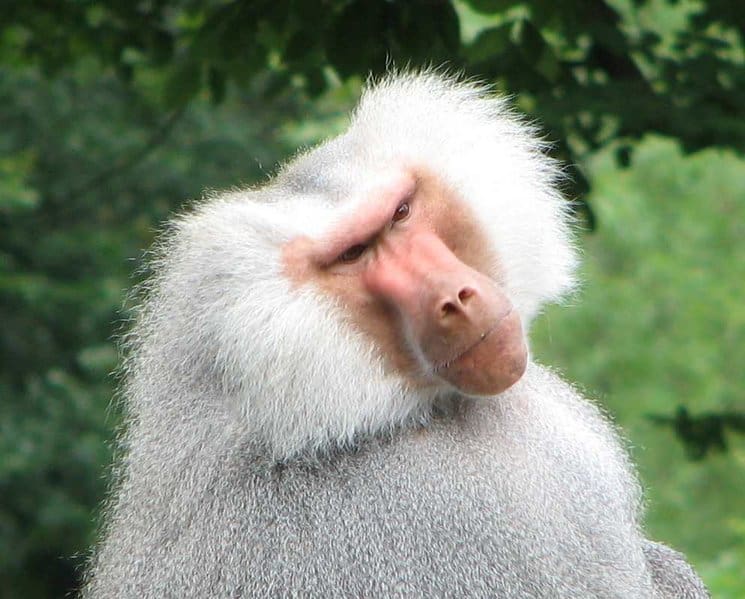
A baboon is a relatively large monkey belonging to the genus Papio. Its physical appearance differs noticeably from many smaller, tree-dwelling monkeys.
Common characteristics include a long muzzle, strong limbs, close-set eyes, prominent canine teeth, thick body hair and a tail that cannot be used to grip branches.
Baboons can climb, but their bodies are particularly well suited to moving across the ground. San Diego Zoo notes that baboons commonly inhabit savannas, open woodland and rocky hillsides while spending most of their time terrestrially.
Explore more African species and destinations in the Hunt Nation Adventure Catalog.
Major Types of Baboons
Baboon taxonomy has changed over time, which explains why older references sometimes provide different species counts. Animal Diversity Web, for example, documents the traditional five-species treatment while also discussing historical taxonomic disagreement.
The major forms readers are likely to encounter include:
Olive Baboon
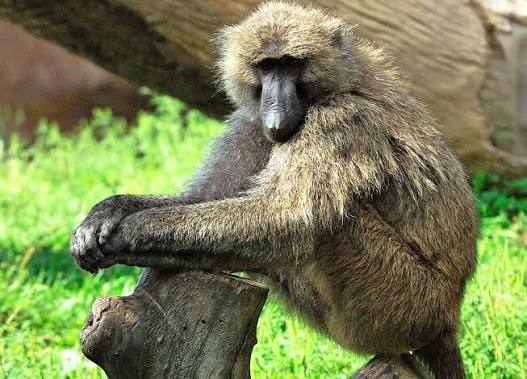
The olive baboon (Papio anubis) is named for the olive-gray appearance created by its coat. It has a broad African distribution and is one of the better-known baboons.
Yellow Baboon
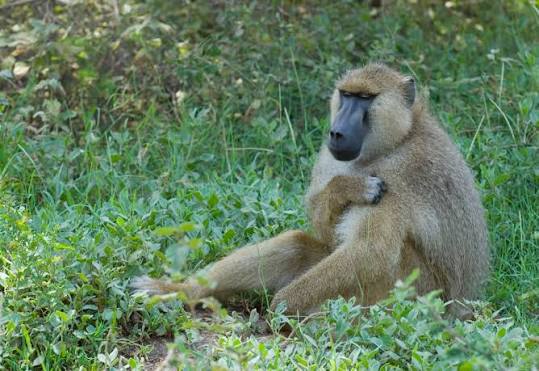
The yellow baboon (Papio cynocephalus) has a generally lighter, yellowish-brown appearance and occurs mainly in eastern and parts of southern Africa.
Chacma Baboon
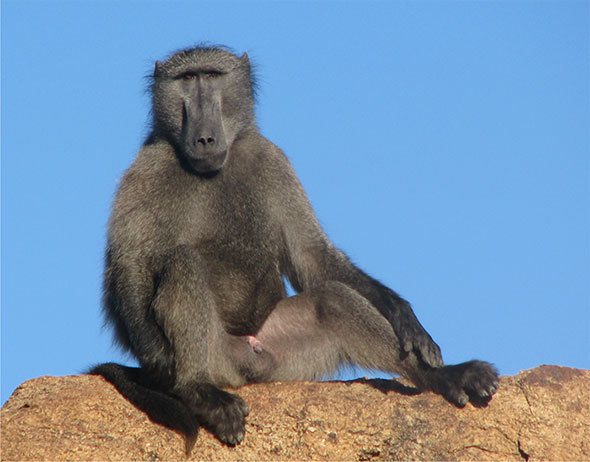
The chacma baboon (Papio ursinus) is strongly associated with southern Africa. It is particularly notable for its large, powerful build.
Hamadryas Baboon
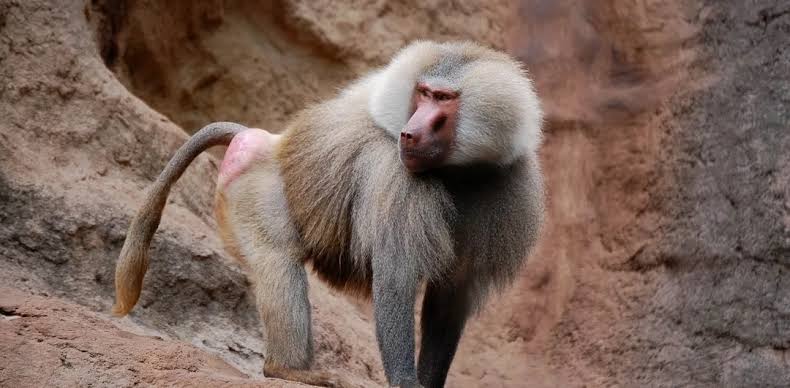
The hamadryas baboon (Papio hamadryas) is among the most visually distinctive.
Adult males develop a long silver-gray mantle, while their faces are largely hairless. Hamadryas baboons inhabit northeastern Africa and parts of the Arabian Peninsula.
Guinea Baboon
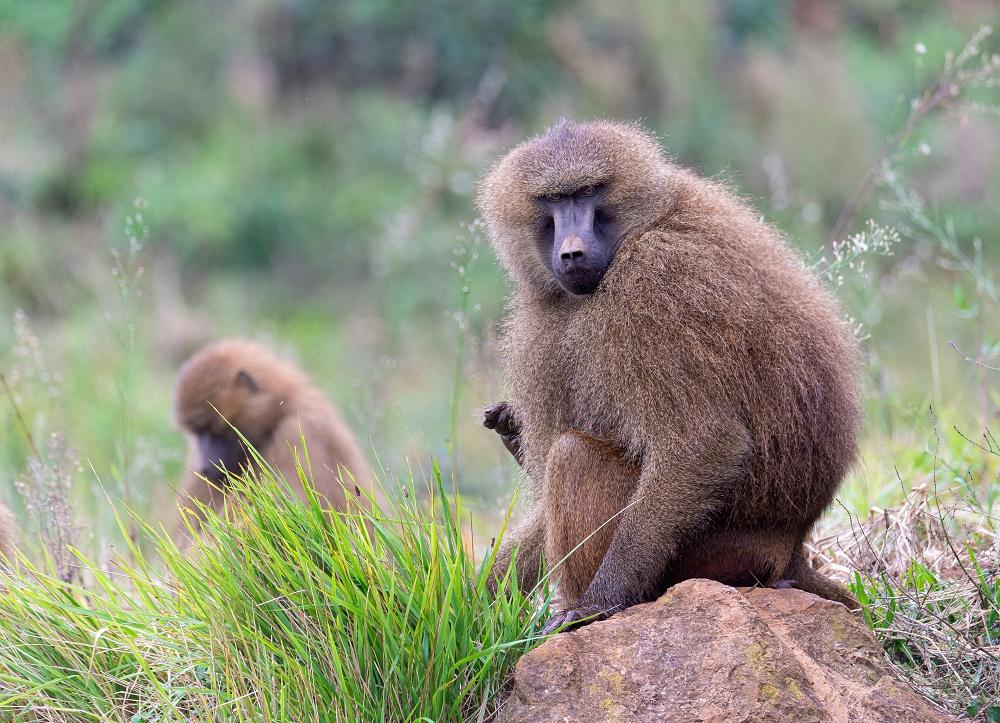
The Guinea baboon (Papio papio) occurs in western Africa, including Guinea, Guinea-Bissau and Senegal, with populations also documented in neighboring areas.
Kinda Baboon
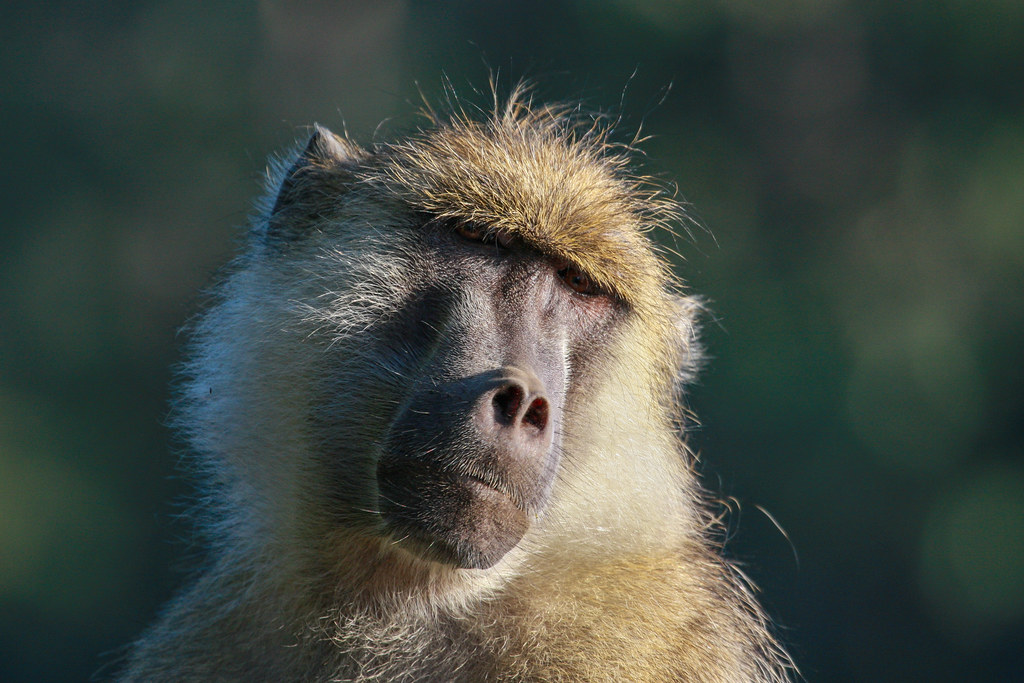
The Kinda baboon (Papio kindae) is recognized in modern treatments as a smaller member of the baboon group and occurs in south-central Africa.
Where Do Baboons Live?
One reason baboons are such an interesting group is their enormous environmental flexibility.
Different populations occur across:
- Southern Africa
- East Africa
- Central Africa
- West Africa
- Northeastern Africa
- Parts of the Arabian Peninsula
Their precise distribution depends on species.
For more information about Hunt Nation’s destinations and wildlife programs, contact our team at 307-637-5495 or info@hunt-nation.com.
Rather than thinking of the baboon as an animal of one particular African landscape, it is more accurate to understand Papio as a group capable of occupying several very different environments.
Baboons in Southern Africa
Southern Africa is especially associated with chacma baboons.
These baboons occupy varied landscapes, including grassland, savanna and wooded highlands. Animal Diversity Web specifically identifies wooded highlands, grassland steppe and savanna among chacma baboon habitats.
Their ability to use many different foods and move efficiently across the ground contributes to this broad habitat tolerance.
Learn more about the wildlife found across Namibia destinations.
Baboons in East Africa
East Africa supports important populations of olive and yellow baboons.
This region includes an enormous mixture of grassland, woodland, rocky terrain and other habitats, allowing baboon ecology to vary considerably between locations.
There are also areas where the ranges of different baboons meet. Smithsonian research highlights overlap between olive baboons in Kenya and hamadryas baboons in Ethiopia, including hybridization where populations come into contact.
Baboons in Northeast Africa and Arabia
This region is particularly important for the hamadryas baboon.
Hamadryas baboons are adapted to comparatively dry environments. Their habitat can include subdesert, savanna, steppe, plains and arid brushland.
High cliffs are particularly important because they provide secure nighttime sleeping locations.
Smithsonian research similarly describes hamadryas baboons of the Horn of Africa and Arabian Peninsula as inhabitants of arid semi-desert ecosystems where seasonal changes strongly influence food availability.
Baboons in West Africa
West Africa is particularly associated with the Guinea baboon.
Compared with some other baboons, its geographic range is relatively restricted. Animal Diversity Web records the species across parts of Guinea, Guinea-Bissau and Senegal, with additional populations reported elsewhere in the region.
This demonstrates why location is important when identifying a baboon rather than assuming all African baboons are the same species.
Baboon Habitat
The typical baboon habitat can include:
- Open savanna
- Grassland
- Woodland
- Rocky hills
- Scrubland
- Semi-desert
- Mountain landscapes
This flexibility is one of the major reasons baboons have established such a broad geographic distribution.
Hamadryas baboons provide a particularly striking example. They can survive in arid environments while remaining dependent on access to water and secure sleeping locations.
Why Baboons Spend So Much Time on the Ground
Baboons challenge the common image of monkeys living almost exclusively in trees.
They are primarily ground-dwelling monkeys.
Their strong limbs allow them to travel considerable distances while searching for food. Trees can still provide food, resting places and protection, but baboons don’t depend on continuous forest canopy for everyday movement.
Some populations even use cliffs rather than trees as important sleeping locations.
Baboon Size
Baboon size varies substantially between species and between males and females.
Males are generally larger, heavier and more muscular.
Hamadryas baboons illustrate this difference clearly. Adult males typically weigh around 40–45 pounds (18–20 kg), compared with approximately 20–25 pounds (9–11 kg) for females.
The difference isn’t limited to weight.
Adult male hamadryas baboons develop a distinctive silver-gray mantle that makes mature males visually different from females.
Male vs. Female Baboons
Baboons exhibit sexual dimorphism, meaning males and females differ noticeably in physical characteristics.
Males commonly have:
- Larger bodies
- Greater overall weight
- More muscular builds
- Larger canine teeth
Appearance can differ further depending on species.
Hamadryas males, for instance, are especially recognizable because of their silver mantle and larger size.
Discover additional species found in South Africa wildlife destinations.
What Do Baboons Eat?
Baboons are omnivores, giving them considerable dietary flexibility.
Their diet can include plant foods such as:
- Grass
- Seeds
- Roots
- Leaves
- Fruit
- Berries
- Flowers
They can also consume insects, eggs and small animals.
San Diego Zoo notes that baboons may consume animal foods such as rabbits and birds, while hamadryas baboons rely heavily on plant material including grass seeds, roots, berries and parts of acacia plants.
Why the Baboon Diet Changes by Region
There isn’t one universal baboon diet.
Food availability changes with rainfall, season, vegetation and habitat.
A baboon living in relatively lush woodland therefore has access to different foods from one inhabiting a dry semi-desert landscape.
This ability to switch between available food sources contributes significantly to baboon survival.
Baboon Social Structure
Baboons are highly social animals.
Their societies involve family relationships, dominance, alliances, competition, cooperation, communication and grooming.
A large social gathering is commonly called a troop, although the precise organization differs substantially among baboon species.
Hamadryas Baboon Social Structure
Hamadryas baboons provide one of the most interesting examples.
Their society is organized at several levels.
The smallest major unit is a one-male unit, consisting of a leader male, females and their young. Multiple units can form clans and bands, while much larger numbers gather at shared sleeping sites.
Smithsonian researchers report that hamadryas troops sharing sleeping sites can easily include hundreds of individuals.
This is much more sophisticated than simply describing baboons as animals that “live in groups.”
Why Do Baboons Groom Each Other?
Grooming is an important part of baboon society.
It helps maintain the coat, but it also performs an important social function.
Regular grooming can strengthen relationships and provide reassurance between individuals.
Hamadryas baboons also use behaviors including lip-smacking and teeth-chattering as reassurance signals, demonstrating that communication extends far beyond vocal calls.
How Do Baboons Communicate?
Baboon communication can involve:
- Vocalizations
- Facial expressions
- Body posture
- Grooming
- Physical contact
- Visual displays
Different signals can have very different meanings.
For example, San Diego Zoo notes that staring can function as a threat signal among hamadryas baboons, while lip-smacking can communicate reassurance.
Interpreting these signals correctly is extremely important for an animal living within a complicated social network.
How Intelligent Are Baboons?
Baboon intelligence is closely connected with their social lifestyle and adaptability.
Individuals must navigate changing relationships while simultaneously finding food, responding to environmental conditions and recognizing potential threats.
Their complex societies have consequently made baboons important subjects for scientific research into primate behavior and evolution.
Baboon Reproduction and Young
Baboon females generally produce a single infant at a time.
For hamadryas baboons, gestation lasts approximately 170 days. Newborns initially cling tightly to their mothers as the troop moves.
Young baboons gradually learn how to navigate their social environment, including communication, relationships and feeding behavior.
This extended period of development is particularly important for animals living in complex societies.
How Long Do Baboons Live?
Lifespan differs between species, populations and environments.
For hamadryas baboons, San Diego Zoo reports approximately 20 years in the wild, while individuals under expert care can live considerably longer.
It is therefore better to treat lifespan as species-specific rather than applying one number to every baboon.
Natural Predators of Baboons
Despite their strength and social organization, baboons remain part of larger African food webs.
Predators vary according to region and habitat.
For hamadryas baboons, documented predators include leopards, hyenas and Verreaux’s eagles.
Group living can provide additional awareness of potential danger.
Elevated sleeping locations also offer protection. Hamadryas baboons gather in large numbers around cliff-side sleeping areas, where group vigilance helps reduce vulnerability.
Baboon Conservation
There isn’t one conservation situation that applies equally to every baboon population.
Species have different geographic distributions and face different local pressures.
Hamadryas baboons, for example, are currently described as having stable or increasing populations and a Least Concern conservation classification. However, agricultural expansion can create habitat loss and greater conflict between baboons and people.
Conservation information should therefore be evaluated at both species and regional levels.
Why Baboons Are So Adaptable
Several characteristics work together to make baboons successful across very different landscapes.
Flexible diet: Their omnivorous feeding behavior allows them to exploit changing food resources.
Ground mobility: Strong bodies enable efficient terrestrial travel.
Intelligence: Behavioral flexibility helps individuals respond to changing conditions.
Social organization: Group living provides communication, social relationships and collective vigilance.
Broad habitat tolerance: Different populations can survive in environments ranging from relatively productive woodland to dry semi-desert.
This combination helps explain why baboons occur across such a substantial portion of Africa.
Baboon Species and Regions at a Glance
| Baboon | Main Region | Distinguishing Feature |
|---|---|---|
| Olive baboon | Broad parts of Africa | Olive-gray appearance |
| Yellow baboon | East & southern Africa | Yellowish-brown coat |
| Chacma baboon | Southern Africa | Large, powerful build |
| Hamadryas baboon | Northeast Africa & Arabia | Silver mantle on adult males |
| Guinea baboon | West Africa | Restricted western distribution |
| Kinda baboon | South-central Africa | Smaller body size |
The regional distinction is useful because identifying where a baboon occurs can immediately narrow down which species is most likely being observed.
Baboon Facts at a Glance
Baboons are Old World monkeys belonging to Papio. They are primarily terrestrial, have non-prehensile tails, live socially and consume both plant and animal foods.
Perhaps most importantly, there is no single “typical” baboon environment.
Some populations inhabit open savannas and woodland, while others survive in rocky and arid landscapes. Hamadryas baboons demonstrate the extreme end of this flexibility through their adaptation to semi-desert environments in northeastern Africa and Arabia.
Frequently Asked Questions About Baboons
What is a baboon?
A baboon is a large Old World monkey belonging to the genus Papio. Baboons are primarily ground-dwelling and occur mainly across Africa.
Where do baboons live?
Baboons occur across different parts of Africa. Hamadryas baboons also extend into the Arabian Peninsula.
What habitat do baboons prefer?
Habitat varies by species and can include savanna, woodland, grassland, rocky hills and semi-desert environments.
What do baboons eat?
Baboons are omnivores. Their diet includes grasses, seeds, roots, fruit and other plant material along with insects and occasional animal foods.
Are baboons monkeys?
Yes. Baboons are Old World monkeys belonging to the family Cercopithecidae.
Do baboons live in trees?
Baboons can climb trees, but they are primarily terrestrial and spend much of their active time on the ground.
What is a group of baboons called?
A group is commonly called a troop, although species such as hamadryas baboons have more complicated multi-level social organizations.
Why do baboons groom each other?
Grooming helps maintain the coat while also strengthening social relationships and providing reassurance.
How long do baboons live?
Lifespan varies by species. Hamadryas baboons can live around 20 years in the wild according to San Diego Zoo.
What is the difference between male and female baboons?
Males are generally larger and heavier and tend to have more prominent canine teeth. The difference is particularly visible in hamadryas baboons, where adult males develop a distinctive silver mantle.
Final Thoughts
The baboon is far more than a familiar African monkey. The genus includes distinct populations adapted to remarkably different landscapes, from southern African savannas to the dry mountains and semi-deserts of northeastern Africa.
Their flexible diet, intelligence, strong terrestrial mobility and sophisticated social organization have enabled baboons to thrive where many more specialized primates would struggle.
Understanding the differences between olive, yellow, chacma, hamadryas, Guinea and Kinda baboons, along with their habitats and regional distributions, provides a much more complete picture of these remarkable Old World monkeys.
Have questions or need more details? Speak with the Hunt Nation team at 307-637-5495 or email info@hunt-nation.com.