The Arctic char (Salvelinus alpinus) is one of the most remarkable cold-water fish in the Northern Hemisphere. Closely related to salmon and trout, this member of the Salmonidae family has adapted to environments ranging from Arctic coastal waters to remote freshwater lakes and rivers.
What makes Arctic char particularly interesting is its diversity. Some populations remain entirely in freshwater throughout their lives, while others migrate between freshwater and the sea.
Its appearance can also vary considerably between populations and seasons, making Arctic char one of the most diverse members of the salmon family.
This guide explores Arctic char habitat, size, diet, range, appearance, lifecycle, adaptations and conservation, along with the important differences between Arctic char, salmon and trout.
Arctic Char Quick Facts
| Feature | Arctic Char |
|---|---|
| Scientific name | Salvelinus alpinus |
| Family | Salmonidae |
| Genus | Salvelinus |
| Common spelling | Arctic char / Arctic charr |
| Distribution | Circumpolar |
| Environment | Freshwater, brackish and marine |
| Maximum reported length | 107 cm |
| Maximum reported weight | 15 kg |
| Maximum reported age | 40 years |
| Diet | Aquatic invertebrates, crustaceans and fish |
| IUCN status | Least Concern |
FishBase reports a maximum recorded total length of 107 cm, maximum weight of 15 kg, and maximum reported age of 40 years, although most Arctic char are considerably smaller and population characteristics vary substantially.
What Is an Arctic Char?
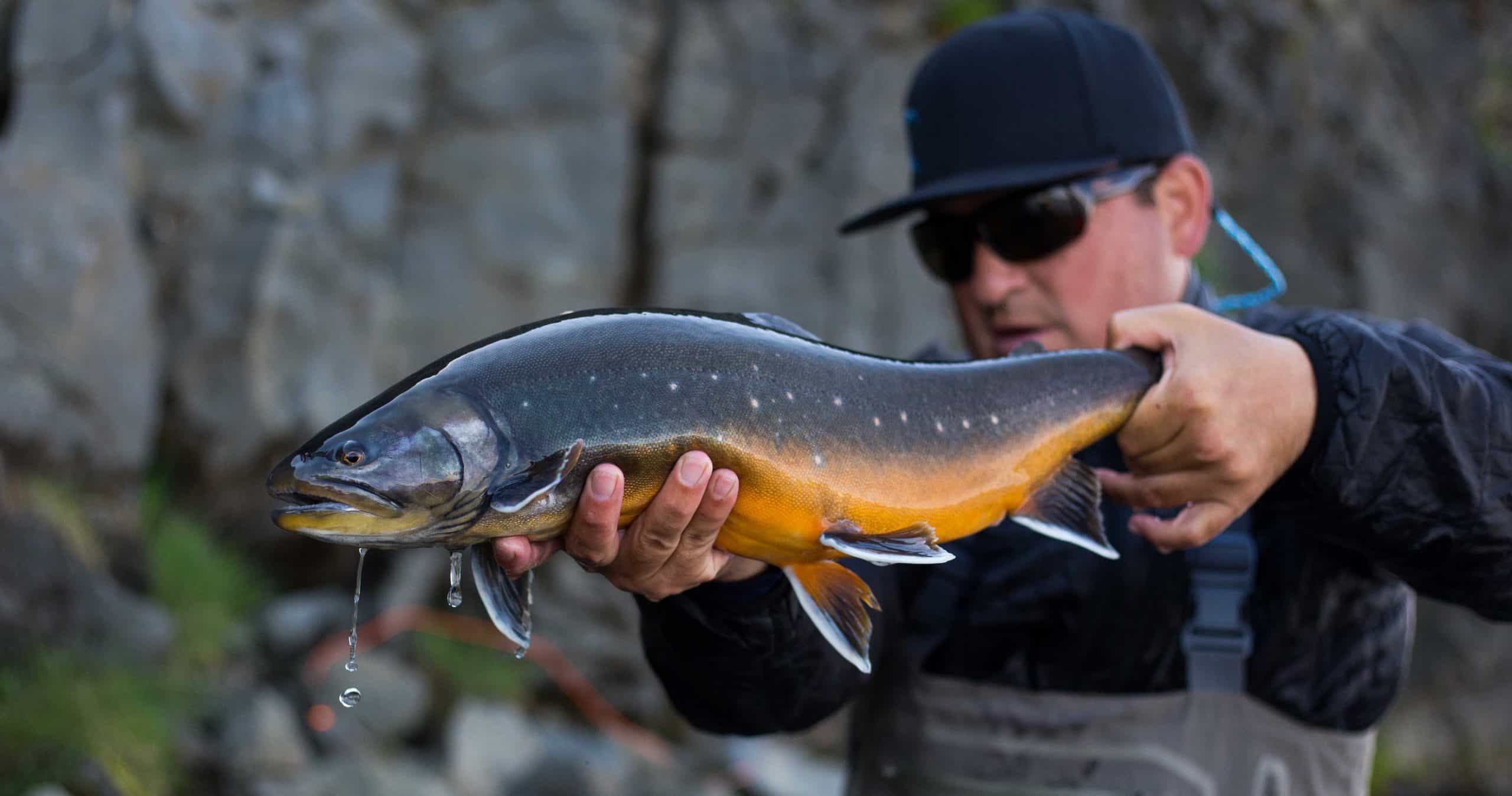
The Arctic char is a salmonid fish scientifically known as Salvelinus alpinus.
That places it within the same family, Salmonidae, as salmon and trout. The U.S. Fish & Wildlife Service classifies it within the genus Salvelinus.
Arctic char have evolved into numerous populations adapted to different environmental conditions.
That flexibility helps explain why one population may spend its entire life in a cold freshwater lake while another moves between rivers and coastal marine environments.
What Does Arctic Char Look Like?
One of the most interesting characteristics of Arctic char is how much its appearance can vary.
In general, the species has an elongated salmonid body.
A useful identification feature is the presence of pink or red spots along the sides and back, rather than the dark spots commonly associated with some other salmonids.
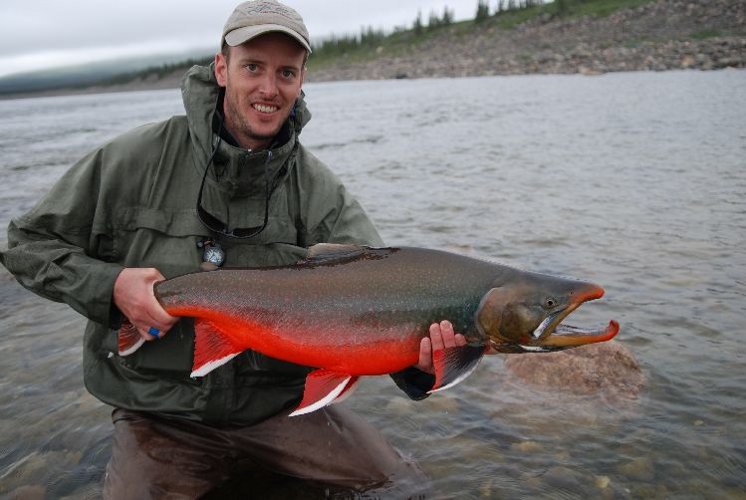
Coloration can change according to population, age, environment and reproductive condition.
This variation is one reason photographs of Arctic char from different locations can appear surprisingly different.
Arctic Char Size
There isn’t one standard Arctic char size.
Growth varies significantly between populations.
FishBase records individuals reaching a maximum reported length of approximately 107 centimeters, or a little over 42 inches.
Maximum reported weight reaches approximately 15 kilograms, or around 33 pounds.
Those numbers represent reported maximums rather than the size an observer should expect from every population.
Environmental productivity, available food, genetics and whether a population has access to marine environments can all influence growth.
Where Do Arctic Char Live?
The Arctic char range is remarkably broad.
The species has a circumpolar distribution across northern portions of North America, Europe and Asia.
Its native range includes areas associated with:
- Alaska
- Canada
- Greenland
- Iceland
- Scandinavia
- Northern Russia
- Northern Siberia
- Arctic islands
In North America, populations occur across Arctic, Atlantic and Pacific drainage systems, with landlocked populations also occurring farther south in parts of northeastern North America.
This enormous geographic range helps explain the species’ considerable biological diversity.
Arctic Char Habitat
The Arctic char habitat is strongly associated with cold water.
Depending on the population, Arctic char can occupy:
- Cold freshwater lakes
- Rivers
- Coastal marine environments
- Estuaries
- Brackish water
- Deep river pools
FishBase describes the species as occurring in freshwater, brackish and marine environments, while the U.S. Fish & Wildlife Service notes that it is adapted to multiple northern aquatic environments.
Cold, clean and oxygen-rich water is particularly important.
Freshwater vs. Sea-Run Arctic Char
Not every Arctic char follows the same lifecycle.
This is one of the most important facts about the species.
Freshwater Arctic Char
Some populations remain within lakes and rivers throughout their entire lives.
These are often referred to as resident or landlocked populations.
Their growth, diet and behavior are shaped entirely by the freshwater ecosystem available to them.
Learn more about Arctic Char in Greenland
Anadromous Arctic Char
Other populations are anadromous.
Anadromous fish move between freshwater and marine environments during their lifecycle.
FishBase notes that these forms can spend significant portions of their lives at sea before returning to freshwater.
This difference contributes to the enormous variation observed among Arctic char populations.
What Do Arctic Char Eat?
The Arctic char diet changes according to habitat, age, season and available prey.
Freshwater populations can consume:
- Planktonic crustaceans
- Amphipods
- Mollusks
- Aquatic insects
- Other fish
Marine individuals can consume several types of small fish and other available aquatic prey.
The species is therefore better described as an adaptable predator than as a fish dependent on one particular food source.
Diet Can Differ Between Populations
Arctic char ecology can become highly localized.
A NOAA-indexed study comparing Arctic char and Dolly Varden in southwestern Alaska found meaningful differences in their feeding ecology.
In that particular ecosystem, Arctic char showed a diverse diet and made substantial use of sockeye salmon eggs when they were available.
This highlights an important point:
There is no single Arctic char diet that accurately represents every population throughout its enormous range.
Arctic Char Lifecycle
The Arctic char lifecycle also varies between resident and migratory populations.
Generally, reproduction occurs in freshwater.
FishBase reports spawning commonly taking place over pebble-to-stone substrates in lakes, while some river populations reproduce within flowing water.
After hatching and developing, resident populations remain within freshwater systems.
Migratory populations eventually move between freshwater and marine environments before returning to freshwater as part of their reproductive cycle.
How Long Do Arctic Char Live?
Arctic char can be surprisingly long-lived.
FishBase lists a maximum reported age of 40 years.
Again, this shouldn’t be interpreted as the normal lifespan of every Arctic char.
Age structures vary substantially between populations depending on environmental conditions, growth rates, food availability and other ecological pressures.
Still, the reported maximum demonstrates how long-lived some populations can become.
How Arctic Char Survive Cold Environments
Cold-water specialization is one of the defining characteristics of Arctic char.
Populations survive in environments where winter conditions can be extreme and biological productivity can be relatively limited.
Their success comes partly from ecological flexibility.
Arctic char can occupy freshwater, brackish and marine environments, while individual populations have developed different feeding strategies and movement patterns.
The species can even be the only fish species present in some northern aquatic systems.
That ability demonstrates just how specialized Arctic char can be for northern environments.
Arctic Char vs. Salmon
Arctic char and salmon are related, but they aren’t the same fish.
Both belong to the Salmonidae family.
However, Arctic char belong to the genus Salvelinus.
Several well-known Pacific salmon species belong to the genus Oncorhynchus, while Atlantic salmon belong to Salmo.
Their coloration and spotting patterns can also differ.
The comparison becomes complicated because both Arctic char and salmon include populations that move between freshwater and marine environments.
So simply describing Arctic char as “another salmon” isn’t taxonomically accurate.
Arctic Char vs. Trout
The distinction between Arctic char and trout can also be confusing because the everyday word “trout” covers multiple salmonid species.
Arctic char are members of the char genus Salvelinus.
Brook trout and lake trout are also members of Salvelinus, despite having “trout” in their common names.
Rainbow trout, by comparison, belong to Oncorhynchus.
Taxonomy therefore provides a clearer distinction than common names alone.
Arctic Char vs. Dolly Varden
Arctic char and Dolly Varden are particularly easy to confuse.
They are closely related and can occur within overlapping geographic areas.
Arctic char are Salvelinus alpinus, while Dolly Varden are Salvelinus malma.
Research from southwestern Alaska has identified differences in diet, head morphology, migration and spawning ecology between populations of the two species living within the same ecosystem.
For readers interested in northern salmonids, understanding this distinction is particularly useful.
Why Arctic Char Vary So Much
One of the most fascinating aspects of Arctic char biology is the amount of variation found within the species.
Populations can differ in:
- Body size
- Coloration
- Diet
- Growth
- Migration
- Habitat
- Reproductive behavior
Even Arctic char living within the same broader geographic region may develop noticeably different ecological characteristics.
Their broad circumpolar distribution and isolation within individual lakes and river systems have helped produce this extraordinary diversity.
Arctic Char Conservation Status
At the global species level, FishBase reports Arctic char as Least Concern, based on an assessment dated August 29, 2023.
However, a global conservation category doesn’t mean every local population has identical conditions.
Some isolated populations can face different environmental pressures.
Because Arctic char depend strongly on cold, oxygen-rich aquatic environments, changes to individual lakes, rivers and watersheds can have locally important consequences.
Why Arctic Char Matter
Arctic char occupy an important ecological position in northern aquatic environments.
They can function both as predators and prey while connecting different parts of freshwater and, for migratory populations, marine food webs.
The species also supports subsistence, commercial and recreational fisheries in different parts of its range.
Their ecological flexibility makes Arctic char particularly valuable for understanding how northern fish populations adapt to dramatically different environments.
Explore Arctic Char in Alaska
Frequently Asked Questions About Arctic Char
What is the scientific name of Arctic char?
The scientific name is Salvelinus alpinus.
Is Arctic char a salmon?
Arctic char and salmon belong to the same Salmonidae family, but Arctic char belong to the genus Salvelinus and are a distinct species.
Is Arctic char a trout?
Arctic char are members of the char genus Salvelinus. Common names within Salmonidae can be confusing because some Salvelinus species are called trout.
Where do Arctic char live?
Arctic char have a broad circumpolar distribution encompassing northern parts of North America, Europe and Asia, including Alaska, Canada, Greenland, Iceland, Scandinavia and northern Russia.
What is the Arctic char habitat?
They occupy cold freshwater lakes and rivers as well as brackish and coastal marine environments. Habitat depends on the individual population.
How big can Arctic char get?
FishBase reports a maximum recorded total length of 107 cm and maximum weight of 15 kg.
What do Arctic char eat?
Their diet can include aquatic insects, crustaceans, amphipods, mollusks and fish, depending on habitat and available prey.
How long do Arctic char live?
FishBase lists a maximum reported age of 40 years, although lifespan varies considerably among populations.
Can Arctic char live in saltwater?
Some populations can. Anadromous Arctic char move between freshwater and marine environments, while other populations remain permanently in freshwater.
Are Arctic char endangered?
At the global species level, Arctic char are currently reported as Least Concern, although individual populations can experience different local conditions.
Final Thoughts
The Arctic char is far more diverse than its name might suggest.
It can live permanently in isolated freshwater lakes or move between rivers and Arctic coastal waters. Some populations remain relatively small, while exceptional individuals have been reported at more than a meter long. Their diets, coloration, migration patterns and growth can all vary according to the environment.