The Aruana, commonly known as the Arowana or Silver Arowana, is one of South America’s most distinctive freshwater fish. Its long silver body, enormous scales, upward-facing mouth and two characteristic barbels make it easy to recognize.
Scientifically known as Osteoglossum bicirrhosum, the Aruana belongs to the Osteoglossidae family. It naturally occurs within major South American freshwater systems, particularly the Amazon basin.
But appearance is only part of what makes this fish remarkable. Aruana are surface-oriented predators capable of leaping from the water to capture prey, and males provide unusual parental care by carrying developing young in their mouths.
This guide covers the Aruana fish habitat, size, diet, range, appearance, behavior, reproduction and key facts.
Aruana Quick Facts
| Feature | Details |
|---|---|
| Common names | Aruana, Aruanã, Arowana, Arawana |
| Scientific name | Osteoglossum bicirrhosum |
| Family | Osteoglossidae |
| Environment | Freshwater |
| Native region | South America |
| Major range | Amazon basin and other northern South American drainages |
| Maximum reported length | About 90 cm in FishBase |
| Maximum reported weight | 6 kg |
| Feeding behavior | Generalist/opportunistic predator |
| Main foods | Primarily insects and other arthropods, plus fish and other available prey |
| Conservation status | Least Concern |
FishBase records a maximum total length of 90 cm and maximum weight of 6 kg, while also listing Aruaná, Arowana and Aruana among names associated with the species.
What Is an Aruana?
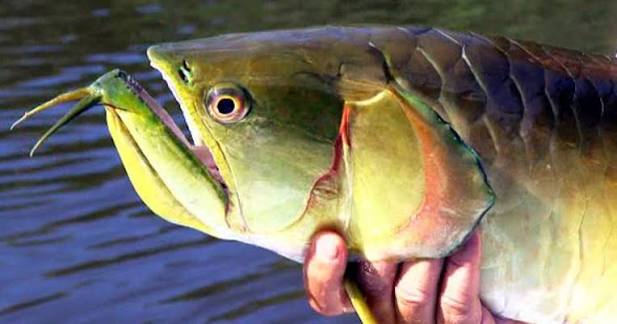
The Aruana is a large tropical freshwater fish belonging to the family Osteoglossidae, commonly known as the arowana family.
Its accepted scientific name is Osteoglossum bicirrhosum. ITIS recognizes “arowana,” “arawana,” “aruana” and “silver aruana” as common English names associated with this species.
The different spellings can create confusion in search results.
For an English-speaking audience, Arowana is particularly common, while Aruanã is widely encountered in Brazil. Therefore, an SEO page targeting “Aruana” should naturally explain these variations rather than treating them as completely different fish.
What Does an Aruana Look Like?
The Aruana has an unmistakable appearance.
Its body is elongated and covered with very large scales. Adults generally have a silvery appearance, while younger fish can display different coloration.
One of its most recognizable characteristics is the pair of barbels extending from the lower jaw.
Its mouth is positioned in a way that helps the fish take prey near the surface. FishBase also notes that the dorsal and anal fins extend far toward the rear of the body.
These characteristics give the Aruana its distinctive streamlined appearance.
Explore more Amazon freshwater species and destinations
How Big Does an Aruana Get?
Aruana are substantial freshwater fish.
FishBase reports:
Maximum recorded length: approximately 90 cm
Maximum recorded weight: approximately 6 kg
Other Amazonian references describe individuals approaching roughly one meter, demonstrating the considerable size mature fish can achieve.
Actual size varies between individuals and environments, so maximum figures should not be interpreted as the normal size of every Aruana.
Where Do Aruana Live?
The Aruana is native to South America.
FishBase records its distribution in the:
- Amazon River basin
- Rupununi River
- Oyapock River
The Oyapock forms part of the border between Brazil and French Guiana.
Brazilian educational sources also document the species in freshwater habitats across Brazil, Peru and Guyana.
Its association with the Amazon makes the Aruana an excellent example of the extraordinary freshwater biodiversity found across tropical South America.
Aruana Habitat
The Aruana habitat is strongly connected with freshwater systems.
It can inhabit:
- Rivers
- Lakes
- Floodplain lakes
- Shallow waters
- Flooded forests
- Vegetated shoreline areas
USGS describes the species as a generalist predator inhabiting shallow blackwater lagoons and littoral areas of Amazonian rivers and lakes. During annual high-water periods, it can also move into flooded forests.
This seasonal connection between rivers and flooded forests plays an important role in its ecology.
A Fish That Lives Near the Surface
Aruana spend considerable time around the upper portions of the water column.
This isn’t accidental.
Their body and mouth position suit a feeding strategy focused heavily on prey found at or above the water’s surface.
FishBase notes that the superior position of the mouth allows the fish to approach prey from underneath.
This surface-oriented lifestyle is directly connected with one of the Aruana’s most famous behaviors: jumping.
Why Do Aruana Jump?
Aruana are powerful jumpers.
They can launch themselves from the water to capture terrestrial insects and other prey associated with vegetation above the surface.
This behavior is especially useful in flooded forests.
During high-water periods, water spreads beneath trees and vegetation, creating an environment where terrestrial insects and other organisms become available to aquatic predators.
The Aruana can exploit this unusual boundary between the aquatic and terrestrial ecosystems.
What Do Aruana Eat?
The Aruana diet is broader than many simple descriptions suggest.
FishBase describes the species as omnivorous with a tendency to feed on fish near the surface. However, newer research provides a more detailed picture of its natural feeding ecology.
A 2025 study conducted in a Central Amazon reserve analyzed 100 Aruana stomach samples across different phases of the annual flood cycle.
Researchers found arthropods to be the dominant food category, leading them to describe the species as a generalist and opportunistic feeder with an insectivorous tendency.
Natural foods can include:
- Insects
- Arachnids
- Crustaceans
- Fish
- Other available animal prey
- Small amounts of plant material
The exact diet changes according to season and prey availability.
How the Amazon Flood Cycle Changes Its Diet
One area where we can go beyond a basic competitor article is the relationship between Aruana feeding and Amazon water levels.
The 2025 Central Amazon study found that feeding patterns changed across flood-pulse periods.
Arthropods represented the dominant food category overall, while the availability and importance of insects, crustaceans and fish varied seasonally.
This tells us something important about Aruana ecology.
They don’t simply search for one food throughout the year. Instead, they can adjust feeding behavior according to what the changing Amazon environment makes available.
Aruana and the Flooded Amazon Forest
Flooded forests are an important part of the wider Amazon ecosystem.
When seasonal waters rise, areas that were previously dry become accessible to fish.
For a surface-oriented predator such as the Aruana, this creates new opportunities.
The fish can move around submerged vegetation while taking advantage of insects and other organisms associated with branches, leaves and flooded forest habitat.
USGS specifically documents the species moving into flooded forest during annual periods of high water.
Aruana Reproduction
The reproductive behavior of the Aruana is particularly fascinating.
Male Aruana provide direct parental care through mouthbrooding.
Instead of leaving the developing offspring unprotected, the male carries eggs and developing young in his mouth.
The Smithsonian’s National Zoo reports that males carry eggs, larvae and early juveniles until the yolk sac is absorbed, a process that can take approximately two months.
This is one of the most distinctive aspects of the species’ lifecycle.
Why Male Mouthbrooding Matters
Fish use many different reproductive strategies.
Some release enormous numbers of eggs with relatively little parental care.
The Aruana follows a very different strategy.
Male mouthbrooding provides developing offspring with protection during an especially vulnerable period.
That parental investment makes reproduction another feature separating the Aruana from many familiar freshwater fish.
Can Aruana Survive Low-Oxygen Water?
Aruana can tolerate challenging freshwater conditions.
FishBase reports that the species is capable of adapting to environments with relatively low oxygen levels.
This ability makes ecological sense given its natural environment.
Amazonian floodplain habitats can change considerably as water levels, temperature, vegetation and biological activity fluctuate throughout the year.
The Aruana’s flexibility helps it persist across these changing conditions.
Aruana vs. Arowana: Are They the Same?
In this context, yes.
Aruana, Aruanã, Arawana and Arowana can all be used in reference to Osteoglossum bicirrhosum.
ITIS lists multiple common names for the species, including:
- Arowana
- Arawana
- Aruana
- Silver aruana
FishBase likewise lists several regional variations.
This is especially important for SEO because someone searching “Aruana” and another person searching “Arowana fish” may ultimately be looking for information about the same species.
Aruana vs. Other Arowanas
The word Arowana is broader than Osteoglossum bicirrhosum alone.
Arowanas belong to the family Osteoglossidae, and related fishes occur outside South America.
Therefore, information about another type of arowana should not automatically be applied to the South American silver arowana.
For this article, the focus is specifically:
Osteoglossum bicirrhosum
That distinction is important when researching size, range, diet and conservation.
Why Is It Called a “Bony-Tongued Fish”?
Arowanas belong to an ancient group commonly associated with the term bony-tongued fishes.
The scientific genus name provides a clue.
The Smithsonian explains that Osteoglossum means “bony tongue,” while bicirrhosum refers to the two characteristic barbels.
This gives the scientific name a direct connection to some of the fish’s distinctive anatomy.
Conservation Status of the Aruana
FishBase currently lists Osteoglossum bicirrhosum as Least Concern, based on an IUCN assessment dated November 4, 2020.
That global classification doesn’t mean individual habitats are free from environmental pressure.
Amazon freshwater ecosystems can be affected by changes to water quality, habitat connectivity and flooded forest environments.
Maintaining healthy river and floodplain systems therefore remains important for Aruana and the many other species sharing these habitats.
Why the Aruana Is an Important Amazon Fish
The Aruana brings together several remarkable adaptations.
It is a large freshwater fish capable of exploiting prey at the surface.
It can leap from the water.
It adjusts its diet as seasonal conditions change.
It moves through flooded forest environments.
And males protect developing offspring through mouthbrooding.
These characteristics make the Aruana far more interesting than its unusual appearance alone suggests.
Frequently Asked Questions About Aruana
What is an Aruana?
The Aruana is a South American freshwater fish commonly known as the Arowana or Silver Arowana. Its scientific name is Osteoglossum bicirrhosum.
Is Aruana the same as Arowana?
When referring to Osteoglossum bicirrhosum, Aruana and Arowana are common-name variations for the same species.
Where do Aruana live?
Their native distribution includes the Amazon basin and the Rupununi and Oyapock river systems of South America.
How big does an Aruana get?
FishBase reports a maximum total length of approximately 90 cm and maximum weight of 6 kg.
What do Aruana eat?
Their natural diet includes insects and other arthropods, crustaceans, fish and other available prey. Recent Central Amazon research found a particularly strong reliance on arthropods.
Why do Aruana jump?
They can leap from the water to capture terrestrial or arboreal prey such as insects associated with vegetation above the surface.
Do male Aruana care for their young?
Yes. Males are mouthbrooders and carry developing offspring in their mouths during early development.
Is the Aruana endangered?
Osteoglossum bicirrhosum is currently listed as Least Concern in the conservation information reported by FishBase.
Final Thoughts
The Aruana is one of the Amazon’s most distinctive freshwater fish.
Its long silver body and huge scales make it visually impressive, but its ecology is even more interesting. Aruana live around Amazonian rivers, lakes, shorelines and seasonally flooded forests, where their surface-oriented feeding strategy allows them to exploit prey both in and above the water.
Recent research also shows why the species shouldn’t simply be described as a fish-eater. Its diet is highly opportunistic, with insects and other arthropods playing a major role and seasonal flood conditions changing which foods are available.
Combined with its jumping ability and unusual male mouthbrooding behavior, these adaptations make Osteoglossum bicirrhosum an exceptional example of life in South America’s freshwater ecosystems.