The Banteng (Bos javanicus) is a large wild cattle species native to Southeast Asia. Recognizable by its muscular body, distinctive white lower legs and contrasting rump patch, the Banteng is one of the region’s most impressive wild bovids.
Banteng once occurred much more widely across Southeast Asia, but wild populations have declined substantially. Today, remaining populations are fragmented across parts of Indonesia and mainland Southeast Asia, making the species increasingly important from a conservation perspective.
For anyone researching Banteng, understanding its habitat, size, diet, distribution, appearance and behavior provides a much clearer picture than simply describing it as wild cattle.
Banteng Quick Guide
| Feature | Details |
|---|---|
| Common Name | Banteng |
| Scientific Name | Bos javanicus |
| Family | Bovidae |
| Animal Type | Wild cattle |
| Native Region | Southeast Asia |
| Diet | Herbivore |
| Typical Habitat | Forest, scrub forest, grassland and forest edges |
| Body Weight | Commonly around 600–800 kg in some references |
| Shoulder Height | Around 1.6 m in large adults |
| Key Identification | White lower legs and white rump |
| Social Structure | Usually small herds |
| Conservation Status | Endangered |
Banteng are closely related to other wild cattle, but their coloration and characteristic white markings make mature animals relatively easy to distinguish.
What Is a Banteng?

The Banteng is a wild member of the cattle family scientifically known as Bos javanicus.
It is native to Southeast Asia and historically occupied a much broader range than many surviving populations do today.
The Banteng has a strongly cattle-like appearance with a muscular body, relatively long legs and horns in both sexes.
One of its most useful identification features is the contrasting white coloration around the lower legs and rump.
Banteng also have an interesting connection with domestic cattle. The domesticated form associated with Banteng ancestry is commonly known as Bali cattle, although domestic and wild animals should not be treated as interchangeable populations.
Learn more about Hunt Nation’s Asian wildlife and destinations guide.
What Does a Banteng Look Like?
A mature Banteng is a substantial animal, but appearance changes according to sex and age.
The most recognizable characteristics include:
- Strong cattle-like body
- White lower legs or “stockings”
- Large white rump patch
- Relatively slender legs
- Horns in males and females
- Noticeable color differences between mature males and females
These white markings are especially useful for distinguishing Banteng from several other large bovids.
Sarawak’s Forest Department similarly identifies white buttocks and white lower legs as important characteristics of the species.
For the latest Banteng pricing and program details, contact Hunt Nation at 307-637-5495 or info@hunt-nation.com.
Male vs. Female Banteng
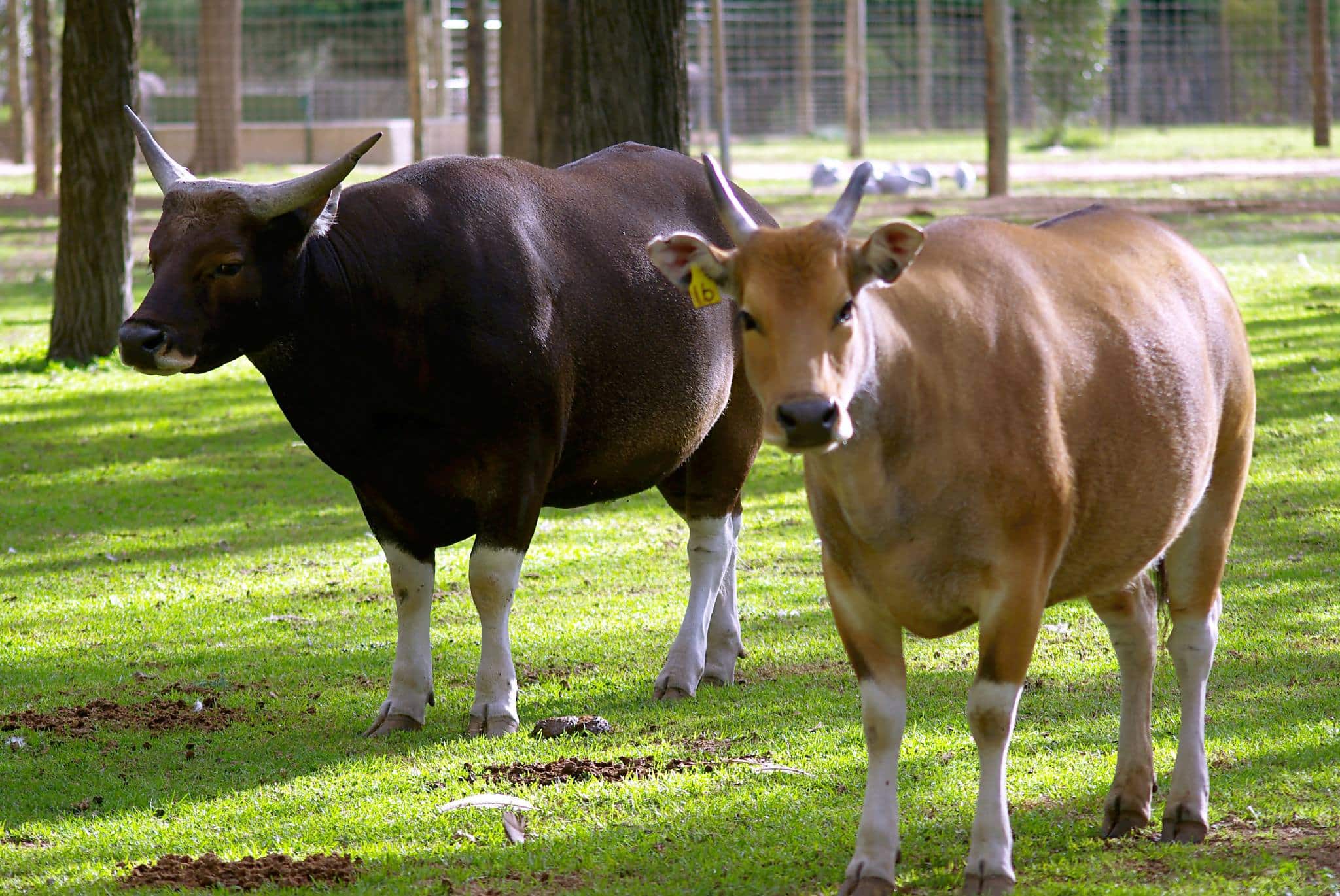
Sexual dimorphism is particularly noticeable in Banteng.
Male Banteng
Adult males typically become much darker as they mature.
Depending on population and age, mature bulls may appear:
- Dark brown
- Blackish-brown
- Almost blue-black
Their horns are also generally heavier and more angular.
Female Banteng
Females are usually considerably lighter.
Typical coloration ranges from brown to reddish or chestnut brown.
They retain the characteristic white lower legs and rump area, creating a strong contrast with the rest of the body.
Animal Diversity Web describes females as brown to reddish-brown, while mature males can become blackish-brown to blue-black.
How Big Is a Banteng?
The Banteng size is one of the features that makes this wild cattle species so impressive.
Animal Diversity Web reports approximately:
| Measurement | Approximate Range |
|---|---|
| Body length | 190–225 cm |
| Shoulder height | Around 160 cm |
| Tail | 65–70 cm |
| Weight | 600–800 kg |
| Male horn length | Up to approximately 60–75 cm |
Other regional references report broader body-weight variation, including animals approaching 900 kg.
Exact dimensions naturally vary according to sex, age, subspecies, location and physical condition.
Where Do Banteng Live?
The native Banteng range is centered on Southeast Asia.
Historically, Banteng occurred across a much larger geographic area. Remaining wild populations are now fragmented and are especially associated with countries and islands including:
- Indonesia
- Cambodia
- Thailand
- Myanmar
- Malaysia
- Laos
- Vietnam
Java and Borneo are particularly important when discussing the species’ surviving island populations.
However, distribution is complicated because many historical populations have disappeared or declined dramatically.
This makes it important to distinguish between the Banteng’s historical range and where viable wild populations remain today.
Banteng in Indonesia
Indonesia is extremely important to the story of the Banteng.
Wild Banteng occur on Java, while populations have also historically occurred on Borneo.
Java supports several important protected populations.
Habitat there can include combinations of forest, grassland and more open feeding areas.
Research indicates that Banteng in Java can occupy semi-deciduous monsoon forest, forest-grassland mosaics and other landscapes providing suitable feeding opportunities and cover.
Indonesia is also closely connected with the domestication history of Banteng through Bali cattle.
Compare Banteng with another large bovine in our Australian Water Buffalo guide.
Banteng in Cambodia
Cambodia historically supported significant Banteng populations.
However, population decline across mainland Southeast Asia has made conservation increasingly important.
Banteng favor landscapes where forest cover occurs alongside more open feeding areas, although surviving populations may sometimes occupy less ideal habitat because of human pressure.
Banteng in Thailand
Thailand is another important part of the Banteng’s remaining mainland distribution.
Modern conservation programs have included the reintroduction of captive-bred Banteng into protected environments.
Research into reintroduced animals at Salakphra Wildlife Sanctuary has examined habitat selection and found factors such as proximity to water and mineral resources to be relevant to habitat use.
Such work provides useful information for conservation programs attempting to restore populations.
Banteng in Myanmar
Banteng populations in Myanmar have experienced substantial pressure.
The Myanmar Biodiversity Portal estimates the country’s wild population at fewer than 250 animals, although it also notes uncertainty around population information.
Important threats include habitat loss and interaction with domestic livestock, alongside historical hunting pressure.
Banteng Habitat
There isn’t one single Banteng habitat.
Depending on location, the species can use:
- Open deciduous forest
- Mixed forest
- Secondary forest
- Grassland
- Scrub forest
- Bamboo areas
- Forest clearings
- Forest-grassland mosaics
Banteng generally benefit from landscapes combining feeding areas with nearby protective cover.
Animal Diversity Web describes them as favoring comparatively open and dry regions close to dense thickets.
Regional differences are important.
In parts of Java and Borneo, Banteng can use secondary forests shaped by disturbance, while mainland populations have historically been strongly associated with more open deciduous forests.
How High Can Banteng Live?
Although often associated with lowland environments, Banteng aren’t limited exclusively to sea-level habitats.
Regional records indicate occurrence from sea level to approximately 2,100 meters in some parts of their native range.
Elevation alone therefore doesn’t define suitable Banteng habitat.
Availability of food, water, mineral resources, cover and relatively undisturbed habitat can all matter.
What Do Banteng Eat?
Banteng are herbivores.
Their diet can include:
- Grasses
- Sedges
- Herbs
- Bamboo
- Leaves
- Shoots
- Fruit
- Flowers
- Bark
- Young branches
They are often described primarily as grazers, but their ability to consume browse and other vegetation means their diet can change considerably according to location and season.
How the Banteng Diet Changes With the Seasons
Season can strongly affect feeding behavior.
During dry periods, grass can form an important part of the diet.
During wetter conditions, Banteng may move into forested or higher areas and consume more bamboo and other vegetation.
Animal Diversity Web specifically notes movement toward forest highlands and bamboo environments during monsoon periods.
This dietary flexibility helps Banteng use environments where food availability changes throughout the year.
Do Banteng Need Water?
Water can be an important component of Banteng habitat.
Some field observations indicate that Banteng regularly use areas near permanent water sources, while mineral licks can also be important.
Research from Southeast Asia has identified water availability and mineral resources among factors affecting habitat selection.
The importance of these resources can vary according to season and local environmental conditions.
Banteng Behavior
Banteng are generally social animals.
Females and younger animals commonly occur in groups, while mature males may sometimes be solitary.
Group size varies considerably according to habitat and local conditions.
Sarawak’s Forest Department reports groups of around 8–10 animals in parts of eastern Sabah, while larger herds have also been recorded.
A typical social group may contain:
- Mature females
- Young animals
- Calves
- An adult male
Older males can spend periods away from larger groups.
Are Banteng Active During the Day or Night?
Activity patterns can change according to environmental conditions and human disturbance.
Banteng may become increasingly nocturnal in areas experiencing greater human pressure.
Sarawak’s Forest Department notes that the species is mainly nocturnal in some areas and suggests this may partly reflect historical hunting pressure.
This is an important reminder that animal behavior isn’t always fixed. Human disturbance can change when wildlife feeds, travels and uses habitat.
Banteng Reproduction
Like other wild cattle, Banteng generally produce a single calf.
Females provide the primary care during the calf’s early development, and young animals remain associated with herd groups.
Reproductive success matters greatly for remaining wild populations because many are already small and geographically isolated.
Where populations become too fragmented, maintaining genetic diversity becomes increasingly difficult.
Banteng vs. Gaur: What’s the Difference?
The Banteng and Gaur are both large Asian wild cattle, so they can sometimes be confused.
However, there are several major differences.
| Feature | Banteng | Gaur |
|---|---|---|
| Scientific name | Bos javanicus | Bos gaurus |
| Build | Large but relatively athletic | Generally heavier and more massive |
| White legs | Distinctive | Also present but body proportions differ |
| White rump | Strong identifying feature | Not equivalent to Banteng marking |
| Male coloration | Dark brown to black | Very dark brown |
| Habitat | Forest/open habitat mosaic | Strongly associated with forested landscapes |
The Banteng’s white rump patch is particularly helpful when distinguishing the two.
Banteng vs. Domestic Cattle
Banteng may resemble domestic cattle, but wild Banteng are a distinct species.
This distinction becomes particularly interesting because Banteng contributed to the development of Bali cattle, an important domesticated form in Indonesia.
Hybridization with domestic livestock can create conservation problems where wild and domestic animals overlap.
Disease transmission from domestic cattle is another concern documented in research on remaining Banteng populations.
Why Are Banteng Important?
Banteng are important both ecologically and scientifically.
As large herbivores, they influence vegetation through grazing and browsing and contribute to nutrient cycling within their ecosystems.
They are also significant for understanding the evolution and domestication of Asian cattle.
Their relationship with Bali cattle makes Banteng especially interesting from the perspective of both wildlife biology and agricultural history.
Banteng Conservation Status
Wild Banteng populations have undergone substantial declines.
Current conservation references classify Bos javanicus as Endangered, with remaining populations fragmented across Southeast Asia.
Major pressures include:
- Habitat loss
- Habitat fragmentation
- Human disturbance
- Illegal killing
- Disease transmission from domestic cattle
- Hybridization with domestic cattle
- Small and isolated populations
The Myanmar Biodiversity Portal cites an estimated global wild population of roughly 4,000–8,000 animals, though population estimates remain uncertain.
This makes protection of remaining populations and suitable habitat particularly important.
Explore more wildlife species in the Hunt Nation Species Catalog.
Why Banteng Populations Have Declined
There is no single reason for the species’ decline.
Suitable lowland habitats have been transformed by agriculture and development in many parts of Southeast Asia.
At the same time, surviving populations can become isolated from one another.
Once a population becomes small and geographically separated, it can face additional problems including reduced genetic diversity and greater vulnerability to disease or local environmental changes.
Research also identifies interactions with domestic cattle as a potential source of disease and genetic contamination.
Banteng Facts at a Glance
Here are some of the most important Banteng facts:
Scientific name: Bos javanicus
Animal family: Bovidae
Native region: Southeast Asia
Diet: Herbivorous
Adult male color: Usually dark brown to blackish
Female color: Typically reddish or chestnut brown
Distinctive markings: White rump and white lower legs
Weight: Commonly reported around 600–800 kg, with regional variation
Habitat: Forest, open woodland, grassland and forest-edge environments
Conservation: Endangered
Domestic connection: Closely associated with Bali cattle
Together, these characteristics make the Banteng one of Southeast Asia’s most distinctive wild cattle species.
Explore More Wildlife With Hunt Nation
Readers interested in learning about additional wildlife species and international destinations can continue exploring Hunt Nation’s species and destination resources.
The best internal linking strategy here is to connect Banteng naturally with broader Asian wildlife and international species guides, rather than adding unrelated links solely for SEO.
Use your existing relevant Hunt Nation species guides here where appropriate, particularly the Asian Sheep guide and other Asian wildlife articles already published on the site.
For upcoming Banteng programs and availability, call 307-637-5495 or email info@hunt-nation.com.
Frequently Asked Questions About Banteng
What is a Banteng?
A Banteng (Bos javanicus) is a species of wild cattle native to Southeast Asia. It belongs to the Bovidae family and is recognizable by its distinctive white lower legs and rump.
Where do Banteng live?
Wild Banteng occur in fragmented populations across Southeast Asia, particularly in parts of Indonesia and mainland countries including Cambodia, Thailand and Myanmar.
What does a Banteng look like?
Adult males generally become dark brown to nearly black, while females are usually reddish or chestnut brown. Both sexes have distinctive white lower legs and a white rump.
How big is a Banteng?
Animal Diversity Web reports Banteng at approximately 190–225 cm in body length, around 160 cm at the shoulder and commonly 600–800 kg in weight.
What do Banteng eat?
Banteng are herbivores that consume grasses, herbs, bamboo, leaves, shoots, fruit and other vegetation. Their diet changes according to season and habitat.
Is a Banteng the same as a cow?
No. Banteng are wild cattle belonging to the species Bos javanicus. However, they have an important relationship with domesticated Bali cattle.
What is the difference between a male and female Banteng?
Adult males are typically larger and much darker, while females generally remain reddish-brown or chestnut colored. Horn shape also differs between the sexes.
Are Banteng endangered?
Yes. Wild Banteng are classified as Endangered, with habitat loss, fragmentation and other human pressures contributing to their decline.
How many Banteng are left in the wild?
Reliable estimates are difficult because populations are fragmented and some areas aren’t thoroughly surveyed. The Myanmar Biodiversity Portal cites a broad global estimate of roughly 4,000–8,000 wild animals.
What is special about the Banteng?
The Banteng combines striking sexual color differences with distinctive white legs and rump markings. It is also important scientifically because of its relationship with domesticated Bali cattle.
Final Thoughts
The Banteng is one of Southeast Asia’s most distinctive wild cattle species.
From the almost black coloration of mature males to the reddish-brown appearance of females and unmistakable white lower legs and rump, the species has characteristics that distinguish it from other large Asian bovids.
But appearance is only part of its story.
Banteng can use forests, open woodland, grasslands and forest-edge environments, adjust their diet as seasonal conditions change and modify their activity patterns in response to disturbance. At the same time, remaining wild populations face serious conservation challenges caused by habitat fragmentation, isolation and other human pressures.
Understanding the Banteng’s habitat, size, diet, range, behavior and conservation status therefore provides a much more complete picture of this remarkable Southeast Asian wild cattle species.